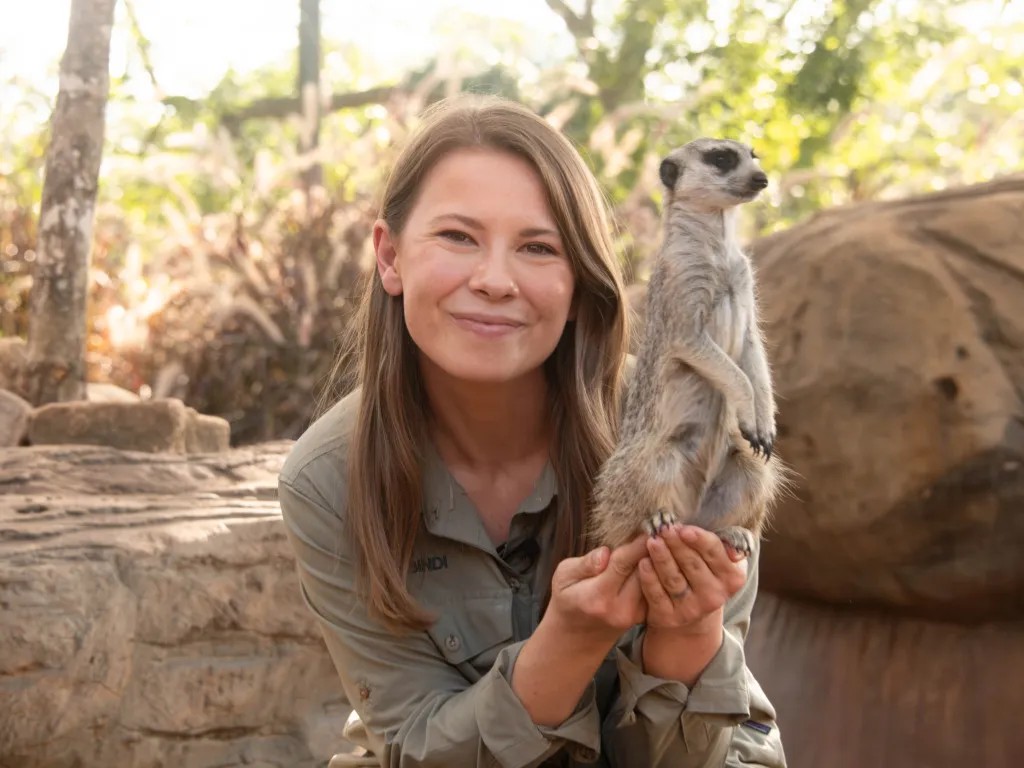
Bindi Irwin’s childhood was defined by the roar of crocodiles and the rustle of rainforest leaves. Today, she is ensuring her daughter, Grace, experiences a similarly untethered existence at the heart of Australia Zoo. Far from a traditional suburban upbringing, Grace is being raised as a “free-range” child in a 700-acre sanctuary home to 1,200 animals.
For Bindi, this is not merely a lifestyle choice but a continuation of a family legacy rooted in wildlife conservation. Alongside her mother, Terri Irwin, and brother, Robert, Bindi manages the zoo—a mission she shares with her husband, Chandler Powell. Together, they are raising the next generation of “Wildlife Warriors,” teaching that empathy for nature is a learned behavior essential for the future of the planet.
A Life Integrated with Wildlife
Life at Australia Zoo is characterized by a seamless blend of domestic routine and wild unpredictability. Bindi describes living in the middle of the zoo, where her “neighbors” include rhinos, birds, and crocodiles. This environment allows for unique interactions that are impossible in conventional settings.
“Grace is a free-range kid; she just runs around and has so much fun with all of our animals,” Bindi explains. “You get to hand-feed kangaroos and scratch rhinos, and it’s just so lovely and so fun.”
This immersion serves a specific educational purpose. Bindi believes that direct contact with animals fosters empathy in children. By observing animals as individuals with distinct personalities rather than abstract concepts, children develop a deeper respect for living beings. This approach aligns with the broader trend in child development that emphasizes outdoor education and nature-based learning as tools for emotional growth.
The Legacy of Steve Irwin
The philosophy guiding Bindi’s parenting is deeply influenced by her late father, Steve Irwin. Known for his infectious enthusiasm and educational mission, Steve dedicated his life to combating the negativity surrounding environmental issues with hope and inspiration.
Bindi recalls that her father never wanted conservation to feel like a burden. Instead, he focused on the joy of discovery and the tangible impact individuals could make. “He really wanted to give people this message of hope and inspiration,” she says. “There is hope for the future, and every little thing that you do to help love the earth and protect our wildlife is gonna make a difference for the future generations.”
By raising Grace in this environment, Bindi is operationalizing her father’s vision. She aims to instill a sense of responsibility that is paired with wonder, ensuring that the next generation views wildlife conservation not as a duty, but as a privilege.
Unlikely Friendships and Personalities
One of the most poignant examples of Grace’s connection to the zoo is her relationship with Igloo, a giant Aldabra tortoise. Despite the size difference, the two share a bond that transcends species. Bindi describes how Igloo eagerly leaves his mud wallow to greet Grace, often anticipating that she might bring him a hibiscus flower.
This interaction highlights a key aspect of the Irwin family’s message: wildlife has personality.
- Individuality: Animals are not monolithic; they have quirks, preferences, and emotions.
- Connection: Grace’s ability to connect with Igloo demonstrates that empathy can bridge the gap between humans and animals.
- Character Building: Bindi notes that these interactions test and build Grace’s character, teaching her patience and kindness.
This perspective challenges the common disconnect many people feel toward wildlife. By humanizing animals through their individual traits, the Irwins make conservation more relatable and urgent.
Grief, Perspective, and Unconditional Love
The Irwin family’s approach to life is also shaped by profound loss. Steve Irwin’s tragic death in 2006 from a stingray barb taught the family a painful but valuable lesson about the fragility of life. Bindi reflects that grief “reveals you” and fundamentally shifts one’s outlook.
“It made me realize how precious life is. Life is fleeting. We don’t know how long we’re gonna get, and it’s so important to spend time with the people that we love doing things that bring us fulfillment.”
This awareness fosters a culture of unconditional love within the family. While disagreements inevitably occur, Bindi notes that working together at the Wildlife Hospital puts minor conflicts into perspective. When faced with the immediate need to save an animal, personal grievances fade away.
“We take the people that we love for granted… it’s so important to make that phone call, spend time with the people that you love, and tell them that they mean the world to you,” Bindi says.
Conclusion
Bindi Irwin’s parenting style is a testament to the power of environment in shaping values. By raising Grace amidst the wild beauty and challenges of Australia Zoo, she is cultivating a generation that views nature with empathy, hope, and responsibility. The Irwin legacy continues not just through conservation efforts, but through the everyday lessons of kindness and connection passed down to the next “Wildlife Warrior.”