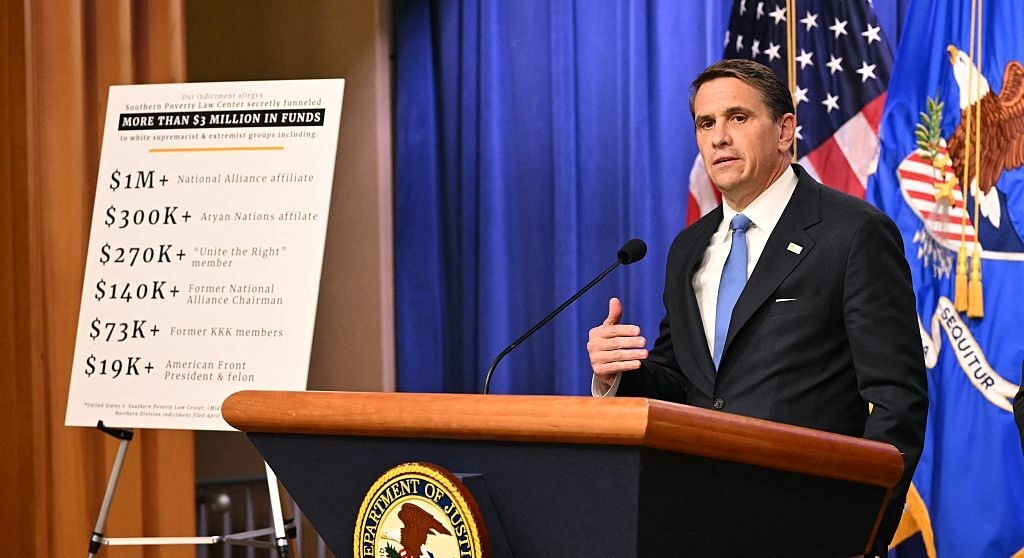
A federal indictment released by the Department of Justice (DOJ) has leveled severe allegations against the Southern Poverty Law Center (SPLC), accusing the Alabama-based organization of orchestrating a massive fraudulent scheme. The DOJ alleges that instead of combating extremism, the SPLC has been actively manufacturing and funding the very “hate groups” it claims to monitor in order to solicit millions of dollars from corporate donors and individuals.
The Core Allegations: Manufacturing Conflict for Profit
According to the indictment announced by Acting Attorney General Todd Blanche, the SPLC has engaged in a deceptive cycle designed to sustain its massive fundraising engine. The primary accusations include:
- Funding Extremism: The DOJ alleges the SPLC funneled millions of dollars to radical groups, including the Ku Klux Klan, to incite the very racial and social tensions the organization claims to fight.
- Artificial Escalation: The indictment suggests the SPLC played a role in inflaming tensions during high-profile conflicts, such as the 2017 unrest in Charlottesville, Virginia, to create a sense of urgency among donors.
- Expanding the “Hate” Definition: Critics and investigators suggest the SPLC broadens the definition of “hate” to include religious and conservative organizations—such as Focus on the Family —thereby increasing the number of groups on its “hate map” and driving up donations.
“The SPLC is manufacturing racism to justify its existence,” stated Acting Attorney General Todd Blanche. “Using donor money to allegedly profit off Klansmen cannot go unchecked.”
The Financial Impact on Corporate America
For decades, the SPLC has maintained a massive financial operation, reportedly raising upwards of $170 million annually. The DOJ’s findings suggest that much of this revenue is obtained through a cycle of “guilt and extortion,” where corporations are pressured to donate to combat perceived hate.
The scale of corporate involvement is significant, with numerous Fortune 500 companies having contributed to the SPLC through grants and donor-advised funds. Notable contributors include:
* Apple, Inc. (which donated $2 million following the 2017 Charlottesville riots)
* Cisco
* Fidelity Investments
* Charles Schwab
* Vanguard
This pattern raises critical questions regarding corporate social responsibility (CSR). If the SPLC is indeed manufacturing the crises it seeks to solve, it suggests that many major corporations have been inadvertently funding the very instability they intended to mitigate.
Real-World Consequences of “Hate Labeling”
The indictment and subsequent analysis highlight that the SPLC’s labeling system is not merely a matter of academic or political disagreement; it carries physical risks. By placing faith-based organizations like the Family Research Council (FRC) on “hate lists,” the SPLC may inadvertently incite violence against those groups.
The text points to a previous incident where an individual, motivated by the SPLC’s designations, attacked a security guard at the FRC with plans for further violence. This underscores the potential danger when non-governmental organizations hold the power to designate groups as “extremist” without rigorous, transparent oversight.
Conclusion
The DOJ indictment marks a significant turning point for the Southern Poverty Law Center, shifting the narrative from one of civil rights advocacy to one of alleged systemic fraud. As the legal proceedings unfold, the focus will remain on whether the SPLC used social instability as a tool for financial gain.